Blog

  • Future-Proofing Warehouse Logistics Under S/4HANA in Malaysia

    The logistics landscape across Malaysia is executing a massive digital shift. Driven by Kuala Lumpur’s booming e-commerce corridors, the expansion of automated distributions hubs in Selangor, and manufacturing expansions in Penang, supply chains are under immense pressure to achieve absolute precision.

    For decades, the standard backend engine driving this physical inventory control has been SAP Warehouse Management (SAP WM).

    However, enterprise IT leads and logistics directors have arrived at a critical crossroads. The official compatibility timeframe for classic SAP WM has closed. For businesses transitioning their ERP systems to the modern SAP S/4HANA database ecosystem, running legacy WM architecture in its old format is no longer an option.

    Organizations face an immediate, strategic baseline choice: migrate full-scale automated hubs to the robust SAP Extended Warehouse Management (SAP EWM) platform, or reconfigure manual storage hubs under the streamlined SAP S/4HANA Stock Room Management framework.

                        ┌─── [Complex/Automated Hubs] ───> SAP Extended Warehouse Management (EWM)

                        │                                   (Advanced Analytics, AI Slotting, Wave Systems)

    [Legacy SAP WM] ────┤

                        │

                        └─── [Simple/Manual Warehouses] ──> SAP S/4HANA Stock Room Management (SRM)

                                                            (Core Bin Upkeep, Standard Putaway & Picking)

    To prevent disruptive supply chain gaps, Malaysian corporate teams must urgently master these updated technical architectures.

    Assessing the Gap: EWM Advanced vs. Stock Room Management

    The primary operational challenge for local supply chains is selecting the correct structural path. Many organizations default to treating their database shift as a minor software update, failing to realize that features have been radically altered.

    If your company runs simple, manual stockrooms or basic maintenance stores with minimal automation, SAP Stock Room Management (SRM) serves as a stable, low-effort bridging alternative. It retains basic inventory management at the storage bin level, goods receipt matching, and standard picking/putaway protocols.

    However, SAP SRM explicitly drops support for advanced legacy components like Task & Resource Management (WM-TRM), Yard Management (WM-YM), and Value-Added Services (WM-VAS).

    For modern, multi-tier distribution networks running complex automated conveyors, automated picking lines, or real-time wave strategies, migrating up to SAP EWM Advanced is mandatory. EWM introduces process-oriented storage control, native Material Flow Systems (MFS), and intelligent AI-powered inventory slotting.

    Attempting to run these updated environments without specialized training leads to severe data mismatch errors, failed RF scanner transactions on the warehouse floor, and extensive processing backlogs that can compromise client fulfillment timelines.

    Earning Baselines: The High Value of Modern SAP Logistics Consultants

    Because planning and executing an enterprise supply chain migration requires an intricate hybrid understanding of physical warehouse movements, material tracking configurations, and ABAP database schemas, qualified SAP Logistics professionals are in exceptionally high demand.

    Data compiled from B2B industrial technical recruitments across Malaysia highlights the premium earning power commanded by certified logistics specialists:

    Core Specialization & ArchitectureAverage Monthly Salary Range (MYR)Enterprise Logistics Business Impact
    SAP Logistics / MM Functional ConsultantRM 8,500 – RM 13,000Designing standard storage bin maps, setting up movement parameters, and handling inventory cycle counting scripts.
    Lead SAP EWM Enterprise ArchitectRM 15,000 – RM 24,000+Engineering multi-site migration roadmaps, integrating Material Flow hardware, and auditing cross-module data compliance loops.

    Securing Fulfillment Continuity via HRD Corp Training Levies

    For corporate leadership and Operations Directors, attempting to resolve warehouse management inefficiencies by continuously relying on expensive external implementation agencies is a financially exhausting approach. The most sustainable strategy is to build a highly agile internal center of logistics excellence.

    By upskilling your current materials handlers, logistics analysts, and internal IT support teams together through structured, hands-on technical modules, you establish an aligned operational language. Your team learns how to perform system compliance checks, run data cleansing scripts prior to cutover dates, and rapidly resolve RF monitor errors on the live warehouse floor.

    Best of all, because these advanced functional tracks are fully recognized under national professional development parameters, Malaysian employers can completely offset their training expenses by leveraging their accumulated corporate levies—turning an administrative requirement into a significant warehouse performance upgrade.

    Master Modern Enterprise Supply Chains

    Whether you are an ambitious functional consultant ready to master the complexities of SAP EWM to unlock senior enterprise consulting tracks, or an operations manager protecting your facility from unexpected distribution downtime, systematic training is your definitive roadmap.

    Lernix provides a comprehensive suite of practical, expert-led training paths engineered specifically to handle real-world supply chain migrations. Review our updated curriculum modules, prerequisites, and flexible corporate enrollment tracks directly on our SAP WM Warehouse Management Training Courses Malaysia page.

    Do you need to schedule a dedicated technical class for your logistics division, customize a workflow syllabus to match your industry’s specific storage layout variables, or verify your company’s HRD Corp claim eligibility? Connect directly with our training strategists through the Lernix Course Inquiry Portal to secure your corporate supply chain roadmap today.
  • Architecting Hardened Infrastructure with RHEL 10 in Malaysia

    The benchmark for enterprise data center security across Malaysia has shifted into a zero-trust model. Driven by strict central bank regulations, tightening personal data safety audits, and sophisticated cloud-native threat environments, maintaining basic server uptime is no longer the sole metric of success for operations teams.

    At the foundation of this secure, transactional enterprise architecture sits Red Hat Enterprise Linux (RHEL).

    However, enterprise systems administration has moved far beyond manually typing bash scripts. With the official closure of extended support for legacy platforms like RHEL 7, and the rapid deployment of the modern RHEL 10 ecosystem across local banking, telecom, and government sectors, the required skillset for infrastructure teams has completely changed.

    Organizations can no longer rely on traditional system administrators who run isolated, unrecorded system tweaks. To survive the modern security landscape, companies require certified experts capable of deploying standardized, immutable operating systems and automated deployment blueprints.

    [Legacy OS Administration] ───> Manual Core Installs ───> Configuration Drift ───> Security Audit Fails

    [Modern RHEL 10 Standard] ───> Image Mode (Containers) ───> GitOps Declarative Code ───> Hardened Compliance

    The Vulnerability of Configuration Drift: Manual Tweaks vs. Immutable Image Mode

    A persistent operational risk for infrastructure managers across the Klang Valley is Configuration Drift. This happens when multiple engineers log into separate staging and production servers to manually patch packages, adjust local user privileges, or tweak firewall rules without recording their changes in a central script. Over time, these undocumented deviations build up, creating silent software incompatibilities and hidden security gaps that lead to system failures during critical audits.

    The modern RHEL 10 ecosystem eliminates this vulnerability by completely altering how the operating system is built, shipped, and managed through Image Mode for Red Hat Enterprise Linux.

    Instead of treating the operating system as a separate layer that must be patched manually on a physical box, RHEL 10 allows teams to define and deploy the entire operating system as a standardized container image.

    ┌────────────────────────────────────────────────────────┐

    │               Enterprise Git Repository                │  <── Source Configuration

    └───────────────────────────┬────────────────────────────┘

                                ▼

    ┌────────────────────────────────────────────────────────┐

    │               Podman / OCI Container Build             │  <── OS-as-Container Compilation

    └───────────────────────────┬────────────────────────────┘

                                ▼

    ┌────────────────────────────────────────────────────────┐

    │        Bare Metal  │  Private Cloud  │  Public Cloud   │  <── Identical Production Nodes

    └────────────────────────────────────────────────────────┘

    By leveraging this containerized operating system method, your infrastructure achieves critical structural advantages:

    • Elimination of Drift: The operating system boots from an unalterable container file, ensuring that every server instance across your company is completely identical.
    • GitOps-Driven Deployment: System adjustments are written directly into configuration files and pushed through code repositories, creating a transparent, auditable history of all environment changes.
    • Post-Quantum Security Frameworks: RHEL 10 introduces advanced, built-in Federal Information Processing Standards (FIPS) for post-quantum encryption, shielding corporate data assets against long-term cryptographic vulnerabilities.

    Transitioning to this container-focused infrastructure architecture requires systematic engineering capability. Without structured, hands-on upskilling, legacy administrators frequently struggle to adapt to immutable file systems, misconfigure network routing profiles inside container loops, or fail to build robust automated deployment playbooks—leaving internal servers exposed to performance bottlenecks.

    Compensation Baselines: The High Value of Certified Red Hat Engineers

    Because designing and maintaining an automated, hardened bare-metal or hybrid-cloud Linux ecosystem demands an intricate understanding of security compliance, network engineering, and container runtimes, certified Red Hat professionals command premium positions across the regional hiring market.

    Data gathered from regional enterprise B2B recruitment directories highlights the premium value assigned to validated systems talent:

    Core Professional CertificationAverage Monthly Salary Range (MYR)Enterprise Infrastructure Business Impact
    RHCSA (Red Hat Certified System Administrator)RM 6,000 – RM 10,500Configuring secure local storage boundaries, managing network routing profiles, and hardening user access permissions.
    RHCE (Red Hat Certified Engineer) / Cloud ArchitectRM 13,000 – RM 22,000+Designing end-to-end automation deployment systems, orchestrating container-converged RHEL 10 image flows, and securing corporate compliance structures.

    Securing Operational Resilience via HRD Corp Training Levies

    For enterprise technology executives and corporate HR leads, attempting to fix server vulnerabilities and system drift by continuously downloading unverified community patches or depending exclusively on third-party consultants is an expensive approach. The most reliable strategy is to systematically upgrade your internal systems team into an aligned, certified core unit.

    By taking your system administrators, network engineers, and security analysts through structured, practical lab training, you build an agile platform engineering squad. Your team learns how to perform in-place upgrades using automated utilities, run real-time diagnostic checks, and manage large-scale deployments without interrupting your daily corporate transactions.

    Best of all, because these high-tier engineering paths line up directly with Malaysia’s national digital transformation frameworks, local employers can completely offset their upskilling expenses by leveraging their accumulated corporate levies—turning an administrative compliance asset into a massive cybersecurity shield.

    Harden Your Enterprise Infrastructure Architecture

    Whether you are an ambitious systems engineer ready to master modern immutable operating system concepts to secure premium global career brackets, or an enterprise leader safeguarding your organization against server vulnerabilities and configuration drift, structured technical training is your definitive roadmap.

    Lernix provides a comprehensive suite of practical, expert-led training paths engineered explicitly to handle the realities of modern enterprise Linux engineering. Review our verified curriculum structures, exam criteria, and corporate calendar modules directly on our Red Hat Linux Certification Training Courses Malaysia page.

    Do you need to organize a dedicated training block for your system infrastructure division, customize an engineering syllabus to match your proprietary cloud configurations, or verify your company’s HRD Corp claim eligibility? Connect directly with our training specialists through the Lernix Course Inquiry Portal to anchor your corporate infrastructure roadmap today.

  • Sample Schemas

    An Oracle database may include sample schemas, which are a set of interlinked schemas that enable Oracle documentation and Oracle instructional materials to illustrate common database tasks.

    software development

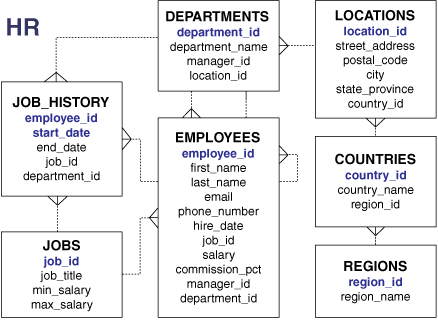
    The hr sample schema contains information about employees, departments and locations, work histories, and so on. The following illustration depicts an entity-relationship diagram of the tables in hr. Most examples in this manual use objects from this schema.

    staff augmentation service

    Figure 2-3 HR SchemaDescription of Figure 2-3 follows
    Description of “Figure 2-3 HR Schema”

    See also

    Oracle Database Sample Schemas to learn how to install the sample schemas

    supply chain

    Overview of Tables

    table is the basic unit of data organization in an Oracle database.

    testing

    A table describes an entity, which is something of significance about which information must be recorded. For example, an employee could be an entity.

    web development

    Oracle Database tables fall into the following basic categories:

    • Relational tablesRelational tables have simple columns and are the most common table type. Example 2-1 shows a CREATE TABLE statement for a relational table.
    • Object tablesThe columns correspond to the top-level attributes of an object type. See “Overview of Object Tables”.

    You can create a relational table with the following organizational characteristics:

    • A heap-organized table does not store rows in any particular order. The CREATE TABLE statement creates a heap-organized table by default.
    • An index-organized table orders rows according to the primary key values. For some applications, index-organized tables enhance performance and use disk space more efficiently. See “Overview of Index-Organized Tables”.
    • An external table is a read-only table whose metadata is stored in the database but whose data is stored outside the database. See “Overview of External Tables”.

    A table is either permanent or temporary. A permanent table definition and data persist across sessions. A temporary table definition persists in the same way as a permanent table definition, but the data exists only for the duration of a transaction or session. Temporary tables are useful in applications where a result set must be held temporarily, perhaps because the result is constructed by running multiple operations.

    This topic contains the following topics:

    • Columns
    • Rows
    • Example: CREATE TABLE and ALTER TABLE Statements
    • Oracle Data Types
    • Integrity Constraints
    • Table Storage
    • Table Compression
  • SYS and SYSTEM Schemas

    All Oracle databases include default administrative accounts.

    managed it services

    Administrative accounts are highly privileged and are intended only for DBAs authorized to perform tasks such as starting and stopping the database, managing memory and storage, creating and managing database users, and so on.

    mobile app development

    The SYS administrative account is automatically created when a database is created. This account can perform all database administrative functions. The SYS schema stores the base tables and views for the data dictionary. These base tables and views are critical for the operation of Oracle Database. Tables in the SYS schema are manipulated only by the database and must never be modified by any user.

    quote

    The SYSTEM administrative account is also automatically created when a database is created. The SYSTEM schema stores additional tables and views that display administrative information, and internal tables and views used by various Oracle Database options and tools. Never use the SYSTEM schema to store tables of interest to nonadministrative users.

    school management

  • Schema Object Dependencies

    Some schema objects refer to other objects, creating a schema object dependency.

    For example, a view contains a query that references tables or views, while a PL/SQL subprogram invokes other subprograms. If the definition of object A references object B, then A is a dependent object on B, and B is a referenced object for A.

    infrastructure services

    Oracle Database provides an automatic mechanism to ensure that a dependent object is always up to date with respect to its referenced objects. When you create a dependent object, the database tracks dependencies between the dependent object and its referenced objects. When a referenced object changes in a way that might affect a dependent object, the database marks the dependent object invalid. For example, if a user drops a table, no view based on the dropped table is usable.

    it consulting

    An invalid dependent object must be recompiled against the new definition of a referenced object before the dependent object is usable. Recompilation occurs automatically when the invalid dependent object is referenced.

    it support

    As an illustration of how schema objects can create dependencies, the following sample script creates a table test_table and then a procedure that queries this table:

    CopyCREATE TABLE test_table ( col1 INTEGER, col2 INTEGER );
    
    CREATE OR REPLACE PROCEDURE test_proc
    AS
    BEGIN
     FOR x IN ( SELECT col1, col2 FROM test_table )
     LOOP
       -- process data
       NULL;
     END LOOP;
    END;
    /
    

    The following query of the status of procedure test_proc shows that it is valid:

    CopySQL> SELECT OBJECT_NAME, STATUS FROM USER_OBJECTS WHERE OBJECT_NAME = 'TEST_PROC';
     
    OBJECT_NAME STATUS
    ----------- -------
    TEST_PROC   VALID
    

    After adding the col3 column to test_table, the procedure is still valid because the procedure has no dependencies on this column:

    CopySQL> ALTER TABLE test_table ADD col3 NUMBER;
     
    Table altered.
     
    SQL> SELECT OBJECT_NAME, STATUS FROM USER_OBJECTS WHERE OBJECT_NAME = 'TEST_PROC';
     
    OBJECT_NAME STATUS
    ----------- -------
    TEST_PROC   VALID
    

    However, changing the data type of the col1 column, which the test_proc procedure depends on in, invalidates the procedure:

    CopySQL> ALTER TABLE test_table MODIFY col1 VARCHAR2(20);
     
    Table altered.
     
    SQL> SELECT OBJECT_NAME, STATUS FROM USER_OBJECTS WHERE OBJECT_NAME = 'TEST_PROC';
     
    OBJECT_NAME STATUS
    ----------- -------
    TEST_PROC   INVALID
    

    Running or recompiling the procedure makes it valid again, as shown in the following example:

    CopySQL> EXECUTE test_proc
     
    PL/SQL procedure successfully completed.
     
    SQL> SELECT OBJECT_NAME, STATUS FROM USER_OBJECTS WHERE OBJECT_NAME = 'TEST_PROC';
     
    OBJECT_NAME STATUS
    ----------- -------
    TEST_PROC   VALID

    loyalty

  • Schema Object Storage

    Some schema objects store data in a type of logical storage structure called a segment. For example, a nonpartitioned heap-organized table or an index creates a segment.

    erp

    Other schema objects, such as views and sequences, consist of metadata only. This topic describes only schema objects that have segments.

    feature

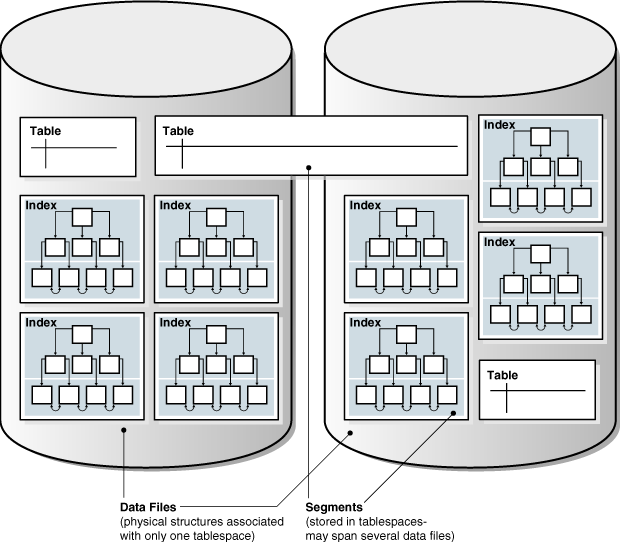
    Oracle Database stores a schema object logically within a tablespace. There is no relationship between schemas and tablespaces: a tablespace can contain objects from different schemas, and the objects for a schema can be contained in different tablespaces. The data of each object is physically contained in one or more data files.

    financial

    The following figure shows a possible configuration of table and index segments, tablespaces, and data files. The data segment for one table spans two data files, which are both part of the same tablespace. A segment cannot span multiple tablespaces.

    Figure 2-2 Segments, Tablespaces, and Data FilesDescription of Figure 2-2 follows
    Description of “Figure 2-2 Segments, Tablespaces, and Data Files”

    See also

    • “Logical Storage Structures” to learn about tablespaces and segments
    • Oracle Database Administrator’s Guide to learn how to manage storage for schema objects

    hrms

  • Schema Object Types

    Oracle SQL enables you to create and manipulate many other types of schema objects.

    crm

    The principal types of schema objects are shown in the following table.

    cyber security

    Table 2-1 Schema Objects

    ObjectDescriptionTo Learn More
    TableA table stores data in rows. Tables are the most important schema objects in a relational database.
    data analytics
    “Overview of Tables”
    IndexesIndexes are schema objects that contain an entry for each indexed row of the table or table cluster and provide direct, fast access to rows. Oracle Database supports several types of index. An index-organized table is a table in which the data is stored in an index structure.“Indexes and Index-Organized Tables”
    PartitionsPartitions are pieces of large tables and indexes. Each partition has its own name and may optionally have its own storage characteristics.“Overview of Partitions”
    ViewsViews are customized presentations of data in one or more tables or other views. You can think of them as stored queries. Views do not actually contain data.“Overview of Views”
    SequencesA sequence is a user-created object that can be shared by multiple users to generate integers. Typically, you use sequences to generate primary key values.“Overview of Sequences”
    DimensionsA dimension defines a parent-child relationship between pairs of column sets, where all the columns of a column set must come from the same table. Dimensions are commonly used to categorize data such as customers, products, and time.“Overview of Dimensions”
    SynonymsA synonym is an alias for another schema object. Because a synonym is simply an alias, it requires no storage other than its definition in the data dictionary.“Overview of Synonyms”
    PL/SQL subprograms and packagesPL/SQL is the Oracle procedural extension of SQL. A PL/SQL subprogram is a named PL/SQL block that can be invoked with a set of parameters. A PL/SQL package groups logically related PL/SQL types, variables, and subprograms.“PL/SQL Subprograms”

    Other types of objects are also stored in the database and can be created and manipulated with SQL statements but are not contained in a schema. These objects include database user account, roles, contexts, and dictionary objects.

    digital transformation

  • 2 Tables and Table Clusters

    This chapter provides an introduction to schema objects and discusses tables, which are the most common types of schema objects.

    microsoft 365 certification training courses malaysia

    This chapter contains the following sections:

    • Introduction to Schema Objects
    • Overview of Tables
    • Overview of Table Clusters
    • Overview of Attribute-Clustered Tables
    • Overview of Temporary Tables
    • Overview of External Tables
    • Overview of Object Tables

    lpi linux administration certification training courses malaysia

    Introduction to Schema Objects

    A database schema is a logical container for data structures, called schema objects. Examples of schema objects are tables and indexes. You create and manipulate schema objects with SQL.

    A database user account has a password and specific database privileges. Each user account owns a single schema, which has the same name as the user. The schema contains the data for the user owning the schema. For example, the hr user account owns the hr schema, which contains schema objects such as the employees table. In a production database, the schema owner usually represents a database application rather than a person.

    lean six sigma certification training courses malaysia

    Within a schema, each schema object of a particular type has a unique name. For example, hr.employees refers to the table employees in the hr schema. Figure 2-1 depicts a schema owner named hr and schema objects within the hr schema.

    Figure 2-1 HR SchemaDescription of Figure 2-1 follows
    Description of “Figure 2-1 HR Schema”

    This section contains the following topics:

    • Schema Object Types
    • Schema Object Storage
    • Schema Object Dependencies
    • SYS and SYSTEM Schemas
    • Sample Schemas

    application services

  • Part I Oracle Relational Data Structures

    This part describes the basic data structures of a database, including data integrity rules, and the structures that store metadata.

    oracle database training courses malaysia

    This part contains the following chapters:

    mysql database training courses malaysia

  • Oracle Database Documentation: Advanced Group

    The advanced group manuals are intended for expert users who require more detailed information about a particular topic than can be provided by the 2 Day + manuals.

    oracle siebel crm training courses malaysia

    The following table lists essential reference manuals in the advanced group.

    oracle peoplesoft training courses malaysia

    Table 1-2 Essential Reference Manuals

    ManualDescription
    Oracle Database SQL Language ReferenceThis manual is the definitive source of information about Oracle SQL.
    Oracle Database ReferenceThe manual is the definitive source of information about initialization parameters, data dictionary views, dynamic performance views, wait events, and background processes.

    The advanced guides are too numerous to list in this section. The following table lists guides that the majority of expert Oracle DBAs use.

    oracle linux administration training courses malaysia

    Table 1-3 Advanced Group for DBAs

    ManualDescription
    Oracle Database Administrator’s GuideThis manual explains how to perform tasks such as creating and configuring databases, maintaining and monitoring databases, creating schema objects, scheduling jobs, and diagnosing problems.
    Oracle Database Performance Tuning GuideThis manual describes how to use Oracle Database tools to optimize database performance. This guide also describes performance best practices for creating a database and includes performance-related reference information.
    Oracle Database SQL Tuning GuideThis manual describes SQL processing, the optimizer, execution plans, SQL operators, optimizer statistics, application tracing, and SQL advisors.
    Oracle Database Backup and Recovery User’s GuideThis manual explains how to back up, restore, and recover Oracle databases, perform maintenance on backups of database files, and transfer data between storage systems.
    Oracle Real Application Clusters Administration and Deployment GuideThis manual explains how to install, configure, manage, and troubleshoot an Oracle RAC database.

    The following table lists guides that the majority of expert Oracle developers use.

    oracle e business suite training courses malaysia

    Table 1-4 Advanced Group for Developers

    ManualDescription
    Oracle Database Development GuideThis manual explains how to develop applications or converting existing applications to run in the Oracle Database environment. The manual explains fundamentals of application design, and describes essential concepts for developing in SQL and PL/SQL.
    Oracle Database PL/SQL Language ReferenceThis manual describes all aspects of the PL/SQL language, including data types, control statements, collections, triggers, packages, and error handling.
    Oracle Database PL/SQL Packages and Types ReferenceThis manual is an API reference for the PL/SQL packages and types supplied with the Oracle database. Packages supplied with other products, such as Oracle Developer or the Oracle Application Server, are not covered.

    Other advanced guides required by a particular user depend on the area of responsibility of this user.